As an Amazon Associate, we earn from qualifying purchases. Some links on this site are affiliate links at no extra cost to you. Our recommendations are based on thorough research and editorial judgment.


Frequently Asked Questions About Golf Swing Analyzers?

Golf swing analyzers are advanced devices that measure swing mechanics, offering key insights for golfers. They assess metrics like clubhead speed, ball speed, and launch angle for real-time feedback. These tools cater to all skill levels, making improvement accessible. Options include glove sensors and club-embedded technology. Some features may require subscriptions for deeper analytics. Despite occasional accuracy issues, trusted models provide reliable readings, helping golfers enhance their game. Discover more about their functionality and benefits.
Key Takeaways
- Golf swing analyzers capture and analyze swing mechanics using sensors, cameras, and radar for real-time feedback and guidance.
- Key metrics include clubhead speed, ball speed, launch angle, and smash factor, providing insights into swing performance.
- Analyzers are suitable for all skill levels, offering immediate feedback that promotes effective skill development and tailored training.
- Many analyzers require subscriptions for advanced features, with trial offers available to test premium capabilities before commitment.
- Limitations include potential accuracy issues and data interpretation challenges, making it essential to prioritize key metrics for improvement.
What Is a Golf Swing Analyzer and How Does It Work?
You may be interested


A golf swing analyzer is a sophisticated tool designed to capture and analyze a golfer’s swing mechanics. Utilizing advanced technologies, these devices record movement through sensors, cameras, and radar systems. They work by gathering data about swing speed, tempo, and angle, providing immediate user feedback for improvement.
Key aspects include:
- On-course and practice analyzers: Track performance both during actual play and training sessions.
- Real-time analysis: Data is processed immediately, facilitating iterative practice.
- Recommendations: Many systems offer tailored guidance to enhance performance.
Through these methods, golfers can identify inefficiencies that might go unnoticed. Ultimately, golf swing analyzers help players improve their skills and lower their average handicap, making the journey toward better golf both measurable and attainable. Additionally, these tools provide insights into key metrics like spin rate, which are crucial for refining swing techniques.
What Metrics Are Commonly Measured by Golf Swing Analyzers?
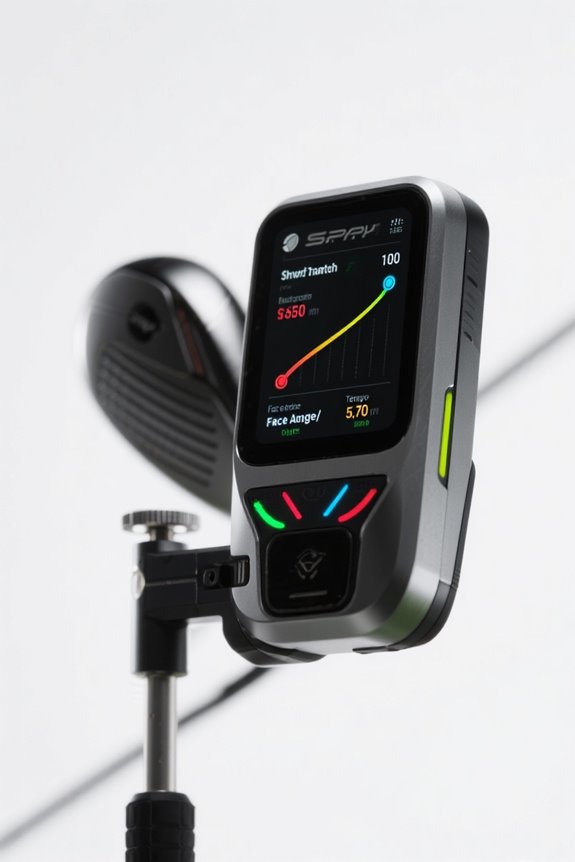
Understanding the metrics measured by golf swing analyzers provides valuable insights into a golfer’s performance. Commonly analyzed metrics include:
- Clubhead Speed: Indicates potential shot distance.
- Ball Speed: Affects carry distance, directly linked to clubhead speed.
- Smash Factor: Reflects the efficiency of energy transfer.
- Launch Angle and Spin Rate: Affect trajectory and control.
- Club Path and Face to Target: Vital for swing accuracy and shot shape.
These metrics are essential for evaluating shot consistency and optimizing gameplay. For instance, analyzing swing tempo can enhance rhythm, impacting overall performance. Gathering this data helps golfers understand their strengths and weaknesses, promoting a communal journey towards improvement. By leveraging these measurements, players can refine their swings and achieve more consistent results. Additionally, utilizing Doppler radar technology can increase measurement precision in swing performance, further enhancing the effectiveness of the analyzer.
How Can a Swing Analyzer Help Improve My Golf Game?
How can a swing analyzer noticeably enhance a golfer’s performance? These devices provide immediate feedback on swing mechanics, allowing for quick adjustments during practice sessions. By identifying technical flaws instantly, golfers can eliminate reliance on subjective observations and focus on specific weaknesses.
Key Benefits:
- Performance Improvement: Data-driven insights accelerate the learning curve.
- Progress Tracking: Longitudinal data helps set realistic goals and visualize improvements.
- Detailed Analysis: Extensive metrics uncover strengths and weaknesses not easily seen.
- Coaching Enhancement: Objective data supports tailored training plans for individual golfers. Additionally, utilizing tools like Orange Whip Trainers can further refine swing mechanics and enhance overall performance.
Utilizing swing analyzers can bridge the gap between amateur and professional training, ensuring that game strategies are informed by precise, actionable data rather than guesswork.
Are Golf Swing Analyzers Suitable for All Skill Levels?

While many golfers may wonder if swing analyzers are truly suitable for their skill level, these devices have been designed with accessibility in mind, making them beneficial for all players. Their skill level adaptability is evident across various models.
- Beginners can focus on basic metrics like swing path.
- Intermediate players benefit from detailed metrics that enhance reliability in swings.
- Advanced users enjoy extensive data for fine-tuning performance.
This user-friendly design guarantees that golfers at any experience level can engage with the same analyzer, promoting progress with scalable features. With instant feedback and data-driven insights, swing analyzers empower golfers to develop their skills efficiently, making them valuable tools for everyone from novices to professionals. Moreover, the accuracy of swing speed radars is crucial for effective training outcomes, ensuring that users receive reliable data to improve their game.
What Types of Devices Are Available for Swing Analysis?

What types of devices are available for swing analysis? Golf swing analyzers come in various forms, leveraging advanced sensor technology to enhance training effectiveness. Here are some key types:
- Glove-attached sensors (e.g., Zepp Golf 2) provide quick feedback on swing faults.
- Club shaft-attached sensors (e.g., Skypro) measure advanced metrics, albeit with additional setup.
- Embedded club sensors (e.g., Garmin Approach) automatically track shot data, simplifying usage.
- Wrist-worn analyzers (e.g., Dewiz) focus on body mechanics during the swing.
- Smart kits for footwork analysis (e.g., Bal.on) improve lower body movement.
Each device caters to different aspects of golf, ensuring personalized training experiences. Golfers can choose based on their specific needs for detailed insights or real-time feedback.
How Do I Connect a Swing Analyzer to My Smartphone or Tablet?
Understanding the connection process for a swing analyzer to a smartphone or tablet can greatly enhance a golfer’s training experience. Here’s how to address potential connection challenges:
- Device Compatibility: Verify the device runs iOS or Android.
- App Installation: Download the designated swing analyzer app from official stores.
- Grant Permissions: Allow necessary permissions, including Bluetooth and camera access.
- Attach the Sensor: Securely connect the sensor to the golf club.
- Pair the Device: Enable Bluetooth and select the sensor from the app’s list.
- Calibration: Follow the calibration instructions to match your user profile. Additionally, consider using a swing recording accessory to capture your swing from optimal angles for better analysis.
What Are Some Popular Models of Golf Swing Analyzers?
Golf swing analyzers have become invaluable tools for golfers seeking to enhance their performance. Among the popular brands are:
- deWiz Golf: Leverages wearable neurofeedback for real-time feedback on swing tempo and changeover.
- HackMotion: Offers detailed wrist data and biofeedback for swing retraining.
- Blast Golf: Attaches to the club, providing pivotal insights into putting and swing feedback.
- Zepp Golf 2: Focuses on basic swing analysis via glove attachment and user-friendly app.
- Skypro: Delivers advanced metrics for all skill levels by attaching to the club shaft.
For on-course performance, Arccos Caddie and ShotScope V5 are popular for shot tracking, with favorable device comparisons emphasizing their capabilities. Each model serves a distinct purpose, catering to diverse golfer needs. Additionally, many golf launch monitors provide comprehensive metrics that help golfers refine their swing mechanics.
What Are the Advantages of Using a Golf Swing Analyzer?
Harnessing the power of technology, golf swing analyzers offer numerous advantages for players aiming to elevate their game. These devices provide instant feedback and help in data interpretation, enhancing practice efficiency. Key benefits include:
- Real-Time Data: Offers insights on club speed, launch angle, and carry distance, allowing for immediate adjustments.
- Targeted Analysis: Tracks swing metrics to identify areas needing improvement, fostering a focused training approach.
- Visual Feedback: High-definition video provides a clear visual comparison with professional golfers, aiding understanding of techniques.
- Progress Monitoring: Records data over time, enabling users to visualize improvements and remain engaged.
- Accessibility: Portable, user-friendly devices democratize performance enhancement, making them suitable for all skill levels.
These elements guarantee a thorough user experience, aligning ambition with measurable progress. Moreover, utilizing advanced technologies can significantly enhance the accuracy and effectiveness of swing measurements.
Are There Any Limitations to Using Swing Analyzers?
While golf swing analyzers provide valuable data-driven insights for improving performance, they also come with several limitations that users should consider. Key limitations include:
- Accuracy Issues: Inertial sensors can produce trajectory estimation errors of 30–60 cm, impacting precision. Sensor calibration and placement affect data reliability.
- Data Interpretation Challenges: Overwhelming data points can complicate improvement efforts. Prioritizing one swing aspect at a time is vital to avoid confusion.
- Equipment Constraints: Some systems require multiple sensors, increasing setup complexity and demands on user expertise. High-end software may also come with a steep learning curve.
- Physiological Oversight: Swing data often neglects individual physical limitations, risking misinterpretation of performance issues.
Recognizing these limitations is essential for effective usage and meaningful improvement. Furthermore, understanding the importance of features in golf sensors can aid in selecting the right technology that aligns with your specific needs.
How Can I Best Use the Data From My Swing Analyzer?
How can a golfer effectively use the data from a swing analyzer to improve their game? Here are actionable steps:
- Phase Analysis: Divide the swing into Address, Ball Impact, and Follow-through. This breakdown helps in isolating faults and strengths, allowing for targeted improvements.
- Key Metrics: Focus on clubhead speed, club path, dynamic loft, face angle, and the face-to-path relationship. Monitoring these will provide insights into power, accuracy, and shot shape.
- Data Interpretation: Use slow-motion comparisons and video analysis to visualize swing mechanics. Track dispersion patterns to gauge consistency.
- Goal Setting: Leverage data to set measurable goals for distance and accuracy. Regularly review and adjust your practice based on swing data to guarantee continuous improvement. Additionally, consider employing advanced tracking technology to enhance your understanding of realistic course simulations, which can further refine your swing mechanics.
Do I Need a Subscription for Some Golf Swing Analyzers?
Do golfers truly need a subscription for some golf swing analyzers? The answer varies based on the product. Many devices operate with different subscription models:
- Free Features: Basic swing capture and limited metrics are often accessible without a subscription.
- Premium Features: Advanced analytics, cloud storage, and enhanced reporting usually require a paid subscription. For instance:
- GSPro software necessitates a yearly fee of $250.
- Apps like Swing Profile charge $9.99 monthly for full functions.
Some models, like Rapsodo, mandate active subscriptions to access features. Many offer free trials, allowing users to test premium capabilities before committing. Consequently, understanding these subscription requirements is crucial for golfers seeking to maximize their performance through precise data. Additionally, features like annual subscriptions may be required for optimal functionality, as seen in products like SkyTrak.
How Accurate Are Golf Swing Analyzers in Measuring Metrics?
Golf swing analyzers offer golfers a valuable tool for improving their game, yet questions remain about their accuracy when measuring specific metrics.
- Swing speed and ball speed readings are dependable, particularly in high-end models like TrackMan.
- Metrics such as hand speed typically show a swing variance of about 1 mph.
- Attack angle and dynamic loft measurements are also reliably assessed, thanks to advanced radar technology.
- However, sensor calibration greatly impacts data accuracy.
- Proper installation of sensors on clubs is essential; incorrect positioning may hinder results.
- Environmental factors, like indoor versus outdoor settings, further influence readings.
Understanding these factors helps golfers utilize swing analyzers effectively to enhance their performance.
Can Swing Analyzers Help With Putting Analysis Too?
Can swing analyzers truly elevate putting performance? Yes, modern putting technology enables golfers to enhance their skills considerably. Devices like Blast Golf focus exclusively on putting strokes, providing vital metrics for improvement. Key features include:
- Stroke Tempo: Evaluates timing between backstroke and follow-through.
- Stroke Consistency: Measures accuracy and direction control.
Blast Golf delivers 11 metrics per stroke, offering immediate feedback. The user-friendly app simplifies complex data, making it approachable for all golfers. Visualization tools, including video analyses, further clarify improvement areas. Plus, subscribers can access personalized coaching plans. Consequently, golfers can cultivate smoother execution and consistent practice routines, allowing for enhanced overall performance on the greens.
What Should I Consider When Choosing a Golf Swing Analyzer?
When selecting a golf swing analyzer, it is essential to contemplate several key factors that can greatly impact performance improvement. Consider the following elements to enhance user experience:
- Device Features: Look for metrics like clubhead speed and 3D swing visualization for thorough analysis.
- Usability: Choose analyzers with intuitive apps that offer clear data visualization and real-time feedback.
- Compatibility: Confirm it works with your preferred devices and supports various clubs for flexible usage.
- Price and Value: Weigh the costs against features, ranging from $99.95 to $249.95.
- Specific Use Cases: Identify your goals—such as focus on short game or swing tempo—to select the right device.
These factors contribute to an effective learning journey, fostering belonging in the golfing community.
Frequently Asked Questions
Can I Use a Swing Analyzer Indoors or Outdoors?
A swing analyzer can be effectively used both in indoor settings and outdoor conditions. Each environment offers distinct advantages, with indoor setups allowing year-round practice and outdoor settings enhancing accuracy through natural ball flight and environmental factors.
How Do I Calibrate My Golf Swing Analyzer?
Calibration techniques require precise sensor alignment, ensuring devices sync accurately with apps. Begin by selecting the correct club type and adjusting settings under the main menu to establish authoritative accuracy and enhance the golfing experience.
Will Using a Swing Analyzer Impact My Swing Feel?
Using a swing analyzer can impact swing feel, as it provides swing feedback that may alter muscle memory. While beneficial for feel adjustments, overreliance might disrupt natural rhythm, emphasizing the need for balance in practice.
Are There Specific Brands Known for Accuracy?
Top brands like Foresight Sports and FlightScope receive exceptional user reviews for their accuracy, making them popular choices among golfers. These analyzers foster a community of users dedicated to improving their skills through precise data insights.
How Do I Maintain My Swing Analyzer for Longevity?
To maintain swing analyzer longevity, employ effective cleaning techniques for sensors and screens, practice diligent battery care by avoiding overcharging, and storing the device correctly, ensuring it remains in peak condition for accurate performance.


