As an Amazon Associate, we earn from qualifying purchases. Some links on this site are affiliate links at no extra cost to you. Our recommendations are based on thorough research and editorial judgment.


Best Swing Analyzer Comparison Guide For Different Skill Levels

For golfers seeking swing analyzers, several key factors come into play. Key features include accuracy, real-time feedback, and video analysis. Beginners may favor user-friendly models like the Zepp Golf 2, while advanced players might benefit from AI-driven systems with dual video streams. Price ranges widely: entry-level options start under $500, while premium models can exceed $7,000. Each analyzer has unique advantages and limitations. Exploring these comparisons can clarify which tool suits individual needs best.
Key Takeaways
- Beginners should consider user-friendly models like Zepp Golf 2 or Blast Golf for accessible metrics and basic practice support.
- Advanced players may benefit from premium options with AI and dual high-speed video for detailed biomechanical analysis.
- Real-time feedback is essential; look for analyzers that offer auditory signals and smartphone app connectivity for immediate corrections.
- Integration with leading golf apps enhances the training experience, allowing golfers to measure progress against established benchmarks.
- Price ranges vary; entry-level models under $500 are suitable for novices, while mid-range and premium options offer advanced features for serious players.
Overview of Swing Analyzers
You may be interested


Swing analyzers have revolutionized the way golfers of all skill levels can improve their game. These devices serve two main categories: on-course swing sensors and practice-focused motion analyzers.
- On-course sensors combine sensor and GPS data, tracking shot distances and performance stats.
- Practice analyzers focus on swing mechanics, measuring details like speed and tempo for technique improvement.
Wearable sensors, such as Zepp Golf, provide easy, portable monitoring, while advanced systems like Swing Catalyst utilize high-speed video for thorough assessments. Moreover, data integration leads to improved performance tracking, allowing golfers to benchmark against professionals. With options tailored for every skill level, swing analyzers support personalized coaching, fostering a sense of community and belonging among golfers motivated to advance. Additionally, portable Doppler radar technology enhances measurement precision, making it easier for golfers to analyze their swing performance effectively.
Key Features to Consider

When choosing a swing analyzer, golfers should consider several key features that can markedly enhance their practice and performance.
- Sensor Accuracy: Look for models with precise sensors that measure swing speed, angle of attack, and more. Accurate positioning is vital for reliable data capture.
- Feedback Timing: Real-time feedback is fundamental. An analyzer that provides instant insights allows golfers to make swift adjustments, improving their game on the spot.
- Video Analysis: Slow-motion playback and side-by-side comparisons can deepen understanding of swing mechanics.
- User Interface: A user-friendly app simplifies complex data and keeps users engaged.
Additionally, choosing a model that integrates with leading golf apps can enhance your training experience by providing comprehensive data analysis. Together, these features guarantee that golfers have the tools necessary for effective practice and continuous improvement.
Recommended Products

What's Included: Enjoy indoor golf simulation with the included Optishot 2, software, USB cable, adjustable rubber tees, and two foam practice golf balls.

Pro-Grade Accuracy with Prometrics Engine: The SC4 Pro golf launch monitor and golf shot tracker delivers precise ball and club head data, tracking from swing to impact to ball flight, offering unmatched real-time accuracy for both indoor and outdoor practice.

Measures » Carry/Total Distance » Smash Factor » Launch Angle » Swing Speed » Apex (Max Height) » Ball Speed
Suitability by Skill Level

Golf swing analyzers vary considerably in their suitability for different skill levels—a factor that aspiring and seasoned golfers alike should consider.
- Beginner Needs: Simpler interfaces and straightforward metrics help novice players grasp fundamentals. Devices focused on short game and putting, like Blast Golf, provide essential features for consistency. Budget-friendly options foster engagement, while video playback aids self-correction. Additionally, features such as practice features found in indoor putting mats can enhance the learning experience.
- Intermediate Players: This group benefits from more detailed data on swing mechanics. Analyzers such as HackMotion assist in controlling wrist angles and clubface, promoting refinement of technique.
- Advanced Features for Low-Handicap Golfers: Advanced golfers require in-depth feedback on impact and backswing. High-quality analyzers offer analytics that suit their better understanding of shot outcomes. Investing in these tools yields significant improvement potential.
Recommended Products

Hit the golf ball further, straighter and more consistently

Golf Swing Analyzer for Home or Business

Advanced Doppler Radar Technology: Equipped with high-precision Doppler radar sensors for real-time, accurate tracking of both ball and club performance.
Technology Used in Analyzers

Technological advancements have transformed golf swing analysis, elevating how players can refine their techniques. Swing analyzers utilize various sensor types to capture essential data. Key technologies include:
- Accelerometers and gyroscopes: Measure swing dynamics like speed and tempo.
- Magnetometers: Enhance orientation tracking for 3D modeling accuracy.
- Optical and infrared sensors: Offer non-contact monitoring of club and body positions.
Moreover, advanced systems like GEARS employ 3D motion tracking, collecting up to 600 images per swing. This enables players to analyze minute mechanical flaws. Combining multiple sensor data enhances precision in biomechanical measurements. Launch monitors, utilizing Doppler radar, provide detailed insights into ball flight characteristics. Overall, these technologies empower golfers at all skill levels to elevate their performance effectively. Additionally, simulators like the FlightScope Mevo+ utilize over 50 parameters for comprehensive performance analysis, ensuring golfers have the data needed for improvement.
Real-Time Feedback Capabilities

The integration of real-time feedback capabilities into swing analyzers enhances players’ ability to perfect their techniques as they practice. Key features include:
- Auditory and Haptic Feedback: Devices like HackMotion provide real-time audio cues, while deWiz uses subtle vibrations to signal swing deviations, allowing for immediate corrections.
- Smartphone Apps and Visualization: Applications such as Swing Profile capture swings via camera, offering instant visual feedback with options for slow-motion replay and frame-by-frame analysis.
- Short Game Focus: Tools like Blast Golf deliver immediate feedback on putting strokes, improving tempo and timing without extensive reviews.
These responsive systems increase swing visualization and facilitate efficient motor learning, enabling players to refine their techniques quickly and effectively, fostering a supportive community of improvement. Incorporating features like advanced measurements can further enrich the training experience by providing comprehensive performance insights.
Detailed Metrics for Analysis
Detailed metrics for analysis play a pivotal role in enhancing a golfer’s performance by providing thorough insights into various swing characteristics. Swing analysis techniques utilize critical data points, allowing golfers to improve their form and accuracy. Key metrics include:
- Swing Speed: Essential for evaluating distance.
- Tempo and Timing: Important for rhythm in full swings and putting.
- Rotation Angles: Analyze shoulder and hip movements.
- Face Angle and Club Path: Diagnose slicing or hooking issues.
Advanced metrics, such as 3D body motion capture and ground reaction forces, provide deeper insights into biomechanics. Understanding these metrics fosters a sense of belonging within the golfing community. Ultimately, data-driven decisions can lead to improved performance and greater enjoyment on the course. Incorporating advanced technologies like Doppler radar can further enhance the accuracy of these metrics.
Putting Analysis Tools
- Blast Motion Putting Analyzer:
- Attaches to the putter grip.
- Analyzes stroke metrics like tempo and face rotation.
- Priced affordably at around $179.95.
- Quintic Ball Roll Software:
- Utilizes a camera to measure ball speed and spin.
- Offers graphical summaries for thorough understanding.
These tools enhance putting drills and foster stroke improvement. By utilizing such technologies, golfers can analyze performance intricacies, identify areas for growth, and achieve measurable progress on the green. Additionally, consistent practice with effective tools can lead to significant improvements in putting performance and skill retention.
Wearable Sensor Technologies
Wearable sensor technologies have emerged as a powerful complement to traditional training tools, greatly impacting golfers’ performance analysis. These advanced devices utilize:
- Inertial Measurement Units (IMUs) to capture critical biomechanical data, improving swing mechanics.
- Coin-sized sensors placed strategically on the body measure essential metrics such as shoulder obliquity and wrist motion.
The lightweight design promotes sensor ergonomics, ensuring natural movements. Additionally, real-time data collection through wearable applications enables instant feedback, enhancing skill adjustment.
Notable benefits include:
- Improved clubface control, reducing errors like slices and hooks.
- Enhanced grip pressure and swing path monitoring.
These technologies provide golfers of all skill levels a pathway to refine their swings, fostering a sense of belonging within the community of performance-driven athletes. Moreover, integrating these tools with swing performance metrics can significantly enhance the training process for dedicated golfers.
User Experience and Usability
How do user experience and usability affect golfers’ adoption of swing analysis technologies? User interface design plays a vital role, as clarity and intuitiveness promote overall user engagement. Key factors include:
- Ease of Setup: Quick setups with minimal manual input encourage regular use. Apps that are plug-and-play draw in casual users, while complex configurations deter them.
- Real-Time Feedback: Immediate corrections accelerate learning. Responsive apps provide hands-free monitoring, enhancing practice sessions.
- Visualization Tools: Features like slow-motion playback and 3D models support detailed swing analysis. Engaging visual aids help users grasp techniques effectively.
- User Support: Accessible tutorials and integrated community features foster a sense of belonging. Clear explanations of swing metrics empower users at all skill levels.
These elements profoundly influence commitment to swing analysis technology. Additionally, effective tools such as golf swing correctors can further enhance the learning experience by providing targeted feedback on specific aspects of the swing.
Price Comparison of Different Models
Understanding the price range of swing analysis technologies is essential for golfers looking to invest wisely. The market trends reveal three distinct pricing strategies:
- Entry-Level Models (Under $500):
- Swing Caddie SC4: $389–$599
- Garmin Approach R10: Around $500
- Sport Sensors Swing Speed Radar: $150–$250
- Rapsodo MLM2PRO: Approx. $700
- Voice Caddie SC4 Pro: Near $599
- Bushnell Launch Pro: Starting at $2,499.99
- Foresight GC3: Near $7,000
- Beginners benefit from structured guidance. They receive easy-to-understand metrics and premade training programs, fostering confidence and reducing the learning curve.
- Intermediate golfers find value in advanced analytics, such as detailed swing plane and tempo analyses. These features help refine consistency and shot control.
- Advanced players are equipped with in-depth wrist angle measurements and 3D biomechanical analysis to pinpoint precise areas for improvement.
- Sensor Accuracy: Placement affects performance. Devices attached to grips may hinder attachment convenience while shaft and glove sensors vary in precision.
- Data Complexity: Some analyzers present overly detailed metrics, which can overwhelm users. Intuitive apps and instructional support, such as videos, enhance comprehension.
- Learning Curve: Advanced instruments may confuse beginners. Devices that segment swings facilitate gradual understanding.
- Cost Considerations: Prices vary widely, with some exceeding $100. Higher costs often correlate with richer feedback and features. Durability and ease of use during practice also matter for practicality.
Prices influence overall ownership costs, as some models include subscription fees for additional features. Golfers should evaluate these factors for a compatible investment. Additionally, understanding the core golf metrics that each model provides can help users make informed choices based on their specific training needs.
Recommended Products

BUNDLE INCLUDES: Full Swing KIT Golf Launch Monitor, Signature Series Power Bundle, and Signature Gift Wrap

BUNDLE INCLUDES: Garmin Approach R10 Golf Simulator, The Net Return Home 7' Wide x 7' Golf Net, and The Net Return duffle bag

TOUR LEVEL SHOT TRACK ACCURACY — Doppler radar & dual camera setup ensure reliable data on every shot to help you improve faster.
Compatibility With Devices
Compatibility with various devices is a crucial factor for golfers investing in swing analyzers. Most modern analyzers support both iOS and Android, enhancing accessibility. However, some models like Swing Tip limit functionality to iOS-only, which can restrict user experience. Device pairing through Bluetooth is standard for real-time data analysis, allowing users instant feedback. Remarkably, devices with built-in displays, such as Swing Caddie SC4 Pro, eliminate the need for external devices. Updates to companion apps improve performance and user experience greatly; popular analyzers like Blast and HackMotion frequently release app updates. Finally, features like integration with Apple Watch further improve usability, offering a sense of community for connected golfers working towards excellence in their game.
Unique Advantages of Each Analyzer
When evaluating swing analyzers, each model offers distinct advantages tailored to specific golfing needs.
Each swing analyzer type is designed with these unique benefits. To summarize, varying skill levels gain targeted insights to enhance their game, making these tools indispensable for golf enthusiasts looking to elevate their performance.
Limitations and Considerations
Evaluating swing analyzers involves not only recognizing their benefits but also acknowledging their limitations. Key considerations include:
Recommendations for Beginners
For beginners seeking to enhance their golf skills, selecting the right swing analyzer can greatly impact their learning experience. Here are some recommendations tailored for new players:
- Zepp Golf 2: A glove-mounted device that simplifies practice with easy club switching and user-friendly metrics.
- SwingSlapp: This mobile app captures swings and offers slow-motion playback, helping visual learners analyze their techniques.
- Blast Golf: Excellent for focusing on putting, it emphasizes basic metrics like tempo and stroke timing, essential beginner tips for consistency.
- deWiz: Provides real-time biofeedback through vibrations, guiding beginners away from common mistakes during practice.
Recommended Products

ZERO ANNUAL FEES + ENVIRONMENTAL SENSORS: Enjoy a smart app with zero subscription required! One-time download, lifetime use, and all features are fully accessible. Built-in temperature, humidity, and barometric pressure modules automatically adjust your shot data to real-time conditions. This provides true-to-life accuracy for both indoor and outdoor training with absolutely no hidden fees.

Measures: Swing Speed, Ball Speed, Carry/Total Distance, Smash Factor, Launch Angle, Apex, Spin (Spin Numbers Available in My Swing Caddie App)

SETUP INSTRUCTIONS: Refer to the user manual for setup, app download, and Bluetooth pairing, and watch the video below for assistance. For troubleshooting, check the tutorials in our Phigolf app.
Recommendations for Advanced Players
Advanced players looking to elevate their golfing performance can substantially benefit from modern swing analyzers designed specifically for their skill level. Key features to evaluate include:
- AI-powered 3D analysis: Provides precise player feedback on swing path and impact position, enabling targeted swing adjustments.
- Markerless Motion Capture: Tracks body movements without sensors, facilitating in-depth biomechanical analysis.
- Dual high-speed video streams: Offers multi-angle reviews, enhancing understanding of swing mechanics.
Advanced analyzers also integrate data from various sources, including force plates and launch monitors. This allows players to correlate swing mechanics with performance outcomes. Subscriptions may be higher, averaging around $65/month, but the insights gained are invaluable for serious golfers. These tools foster continuous improvement, essential for competing at higher levels.
Recommended Products

Advanced Golf Launch Monitor – The Rapsodo MLM2PRO golf launch monitor delivers pro-level accuracy, measuring 13 core golf metrics, including spin rate, spin axis, and swing speed, making it a golf training aid

MOST ADVANCED LASER EVER: The Series 4 Ultra Laser Rangefinder sets a new standard for premium performance, taking our flagship design to the next level. Designed for players who seek unbeatable accuracy, the S4 Ultra offers flag lock precision up to 350 yards, ensuring you never second-guess your shot. Its sleek, ergonomic design features a crystal-clear OLED display and 6x magnification. With an IP54 weather-resistant rating, the S4 Ultra is your trusted companion in any weather.
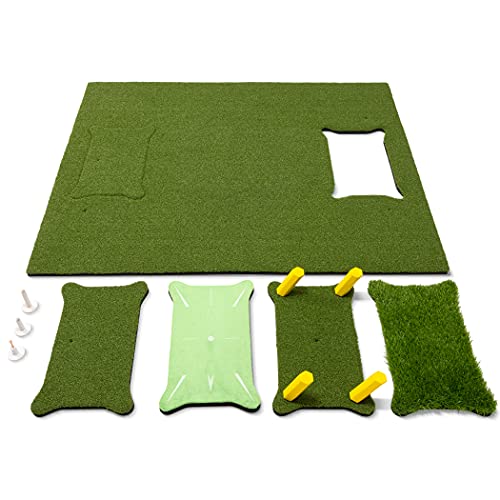
PRO GOLF MAT: Features interchangeable hitting mats for practicing key swing elements at home, fix hooks/slices, fat or thin shots and improve swing path, impact position, ball striking and more
Frequently Asked Questions
How Do Weather Conditions Affect Swing Analyzer Performance?
Weather conditions dramatically influence swing analyzer performance; temperature variation and humidity impact sensor accuracy, leading to potential errors. External factors, like moisture and wind, can complicate readings, making precise swing evaluation a challenging endeavor.
Can I Use Multiple Swing Analyzers Simultaneously?
Multiple swing analyzers can be used simultaneously if compatible. This enables players to capture diverse angles and data streams together, enhancing the overall analysis, provided that the appropriate hardware and software integrations are in place.
Are Swing Analyzers Beneficial for Other Sports?
Swing analyzers, akin to modern-day alchemy for athletes, provide significant swing analysis benefits across sports. By refining mechanics through advanced sports equipment, they foster skill development, reduce injury risks, and cultivate a sense of community among players.
How Often Should I Practice With a Swing Analyzer?
Practicing with a swing analyzer should align with individual skill levels. Beginners might focus on 1-3 times weekly, while intermediate players benefit from consistent weekly practice. Ultimately, training consistency enhances improvement and fosters a supportive golfing community.
What Are the Most Common User Mistakes When Using These Devices?
Common user mistakes with swing analyzers often involve flawed data interpretation and neglecting device calibration. Users frequently misjudge results, focus on raw metrics, and overlook essential fundamentals, undermining their journey toward improvement and shared success in golf.


