As an Amazon Associate, we earn from qualifying purchases. Some links on this site are affiliate links at no extra cost to you. Our recommendations are based on thorough research and editorial judgment.


How Do Golf Simulators Compare To Real Course Experience?

Golf simulators differ greatly from real course experiences. They offer accurate metrics, with devices like TrackMan achieving 90-95% accuracy. However, they can’t replicate terrain undulations or outdoor conditions, affecting realism. Scores tend to be lower due to idealized settings, possibly misleading improvement assessments. Simulators provide year-round convenience and social interaction, yet they lack natural sensory feedback. Understanding these distinctions can enhance a golfer’s practice approach and game insights, leading to more informed decisions. Explore further to discover details on skill development and training benefits.
Key Takeaways
- Golf simulators offer high accuracy in metrics but lack the physical undulations and environmental influences found on real courses.
- Playing conditions on simulators are ideal, leading to lower scores compared to unpredictable grass and natural hazards encountered outdoors.
- Simulators provide year-round access, flexible scheduling, and social opportunities, enhancing convenience for busy golfers.
- High-definition graphics replicate famous courses, but they cannot fully recreate the sensory experience of being outdoors.
- The physical challenge and psychological aspects of real golfing are diminished in simulators, affecting gameplay realism.
Accuracy and Measurement Precision
You may be interested


When evaluating the accuracy and measurement precision of golf simulators, it is essential to contemplate the underlying technology that drives these devices.
- Modern simulators utilize radar or high-speed camera systems for capturing critical metrics.
- For instance, TrackMan tracks over 40 metrics with an accuracy of about 90-95% in key areas like ball speed and distance.
- Foresight GCQuad offers professional-grade precision using triple-camera infrared technology.
Data reliability is high across premium simulators, often achieving measurement variance within 1-3%. This precision greatly aids in refining skills and club fitting. However, while simulators provide consistent conditions, they’re limited in replicating all real-world factors. Understanding these technological strengths can enhance a golfer’s practice and allow for informed decision-making. Furthermore, simulators like the FlightScope Mevo+ provide detailed performance analysis through advanced data metrics, enhancing the training experience.
Recommended Products

SKYTRAK ST MAX Launch Monitor – Delivers tour-level accuracy with dual Doppler radar, photometric cameras, and GOLFTEC Speed Training to help you build speed and distance - plus dual ports so you can charge and play without interruption.

Fine-tune your form with this premium launch monitor and simulator that utilizes a 3-camera system for precision metrics

All-In-One Golf Simulator Studio: Comes complete with the SkyTrak ST MAX launch monitor, durable enclosure, impact screen, steel frame, premium 5×5 hitting mat, and ZW350ST short-throw projector — everything to build your indoor golf setup quickly.
Differences in Playing Conditions and Challenges

Understanding the differences in playing conditions and challenges between golf simulators and real courses can substantially enhance a golfer’s approach to the game.
- Terrain Variability:
- Simulators approximate slopes with moving swing plates, but they cannot replicate real terrain’s unpredictable undulations.
- Ball lies on mats are consistently favorable compared to variable grass conditions outdoors.
- Real courses are affected by wind, temperature, and humidity, influencing shot strategy and comfort.
- Simulators provide virtual weather but lack the sensory experience of outdoor play.
- Traversing a real course demands walking and adjusting for natural obstacles, which enhances physical fatigue and decision-making. Additionally, using a ball flight tracker can help golfers analyze their swings and adapt to different conditions more effectively.
- Controlled Conditions: Simulators often produce lower scores due to ideal setups, including flat lies and no environmental challenges.
- Hazard Exclusions: The absence of bunkers and rough in simulators simplifies the game.
- Gimmies: Short putts may be automatically counted, reducing difficulty.
- Handicap Calculations: Reported simulator handicaps can be markedly lower than actual ones, sometimes by several strokes.
- Weather adaptability: Uninterrupted practice year-round, no matter the weather. Rain, snow, or extreme heat won’t disrupt training.
- Practice accessibility: Flexible scheduling to accommodate busy lives, allowing sessions at convenient times.
- Data-driven feedback: Real-time metrics on performance help players focus on specific improvements.
- Cost efficiency: Reduced travel time and no green fees lead to savings, allowing for more frequent play.
- High-definition graphics that replicate famous courses like St. Andrews and Pebble Beach.
- Software like GSPro and E6 Connect that prioritize visual accuracy and immersive environments.
- Detailed terrain textures that differentiate fairways, roughs, and bunkers.
- Approximately 86% of golfers who use simulators improve their swing consistency within three months.
- Advanced launch monitors deliver precise metrics including ball speed and spin rate, offering invaluable real-time feedback.
- Controlled conditions enable focused practice on swing mechanics, free from environmental distractions.
- This repetition fosters muscular adaptation, critical for developing muscle memory and correcting swing faults.
- However, players may face challenges when shifting to outdoor courses due to the absence of real-life variables like wind and terrain.
- Many simulators, like the SkyTrak launch monitors, utilize advanced technology to provide accurate club and ball data, enhancing the training experience.
- Convenience: Year-round access, playable in varied spaces, and no waiting times.
- Social Interaction: Offers multiplayer setups and community engagement through competitions.
- Data Insights: Advanced analytics provide instant feedback, aiding skills improvement. In comparison to traditional methods, simulators often utilize advanced analytics that track over 22 parameters for precise performance analysis.
- Financial Investment: High-quality systems require substantial costs, often beyond casual budgets.
- Realism Constraints: Lacks the full sensory experience of outdoor play, affecting some golfing aspects.
- Space Needs: Can demand considerable room, limiting availability for some users.
Recommended Products

The Golf Hitting Mat Built for Real-World Performance: After testing countless golf mats, we realized that golfers deserve better. That’s why we created the SIGPRO Golf Mat. This indoor golf training mat delivers the real feel of a fairway with proprietary Teeline turf layered over ABS Polyurethane Flex, engineered to mimic real grass. Every swing provides realistic feedback on clean shots while remaining forgiving on fat shots and mishits, offering consistent, course-accurate practice indoors.

REALISTIC FAIRWAY SIMULATION: With 110 ounces of nylon, this mat enables golfers to achieve that coveted Down-and-Through motion, replicating the experience of a genuine fairway. Dense nylon fibers, coupled with the 5/8” closed cell foam pad, deliver authentic feedback on all your shots, whether they're fat, thin, or pure.

REALISTIC FAIRWAY SIMULATION: With 110 ounces of nylon, this mat enables golfers to achieve that coveted Down-and-Through motion, replicating the experience of a genuine fairway. Dense nylon fibers, coupled with the 5/8” closed cell foam pad, deliver authentic feedback on all your shots, whether they're fat, thin, or pure.
Scoring and Handicap Discrepancies

Scoring discrepancies between golf simulators and real courses can greatly impact a player’s perception of their game. Key factors include:
Players might feel misled by simulator scores that closely match or exceed their best real course performances. This misrepresentation can skew assessments of skill improvement and progress, as simulator limitations do not reflect the true challenges faced outdoors. Furthermore, understanding the advanced performance metrics in simulators can help players better gauge their actual skills against real-life conditions.
Convenience and Year-Round Practice Benefits

Golf simulators offer notable convenience and consistent opportunities for practice, greatly enhancing a player’s training regime. They provide:
Moreover, indoor environments promote engagement among friends and family, fostering a sense of belonging in a shared activity. With these advantages, players can maintain consistent training momentum and improve readiness for outdoor courses. Golf simulators truly represent a modern solution for avid golfers, especially when considering their advanced tracking technology that enhances the overall practice experience.
Recommended Products
All-In-One Golf Simulator Studio: Comes complete with the SkyTrak ST MAX launch monitor, durable enclosure, impact screen, steel frame, premium 5×5 hitting mat, and ZW350ST short-throw projector — everything to build your indoor golf setup quickly.
Precision Tracking Technology: Fine-tune your form with this premium launch monitor and simulator that utilizes a 3-camera system for precision metrics

[Built-In Display & 8-Hour Battery – Train Anywhere] View key data instantly on MINI’s display—no PC needed. Use iPad for 3D visuals outdoors or PC for full simulation indoors. Seeing your data clearly, even outdoors, builds confidence and motivates focused practice.
Immersive Experience and Visual Realism

The immersive experience of using golf simulators has transformed how players engage with the game, particularly through advanced visual realism. Modern simulators feature:
While simulators offer virtual landscapes, the authentic ambiance of real courses remains elusive. High-quality projectors deliver crisp images, but they cannot fully replicate the dynamic conditions of natural elements. Players enjoy varied course layouts and designs, yet sensory feedback from real experiences—including wind, temperature, and tactile sensations—remains unmatched. Consequently, while simulators offer a creative alternative, they lack the emotional and physical connection found on actual courses. Additionally, the simulation accuracy significantly influences training effectiveness, enhancing the overall experience for players.
Impact on Skill Development and Training
Skill development in golf has been considerably influenced by the introduction of simulators, which provide a unique platform for training and practice.
Recommended Products

Enhance Your Training with 3-Camera Precision: Equipped with a sophisticated 3-camera system, Premium Golf Launch Monitor and Simulator Approach R50 captures detailed ball and club metrics that reveal insights like ball speed, launch angle, and face-to-path alignment. This data allows golfers to finetune every aspect of their swing with precise feedback, making it an ideal tool for dedicated players looking to improve both indoors and outdoors with consistent accuracy.

BUNDLE INCLUDES: Full Swing KIT Golf Launch Monitor, Signature Series Power Bundle, and Signature Gift Wrap

[Real-Time Tracking with Dimple & Club Optix] High-speed cameras and infrared sensors provide near-zero latency. Dimple Optix reads any dimple pattern. Club Optix delivers real-time visuals of your club at impact.
Overall Benefits and Limitations of Simulators
In evaluating golf simulators, a thorough look at their overall benefits and limitations reveals a multifaceted tool that can cater to diverse golfing needs.
Benefits:
Limitations:
Ultimately, while simulators enhance accessibility and enjoyment, they cannot completely replicate the real course experience, presenting a balance of pros and cons.
Recommended Products
All-In-One Golf Simulator Studio: Comes complete with the SkyTrak ST MAX launch monitor, durable enclosure, impact screen, steel frame, premium 5×5 hitting mat, and ZW350ST short-throw projector — everything to build your indoor golf setup quickly.

BUNDLE INCLUDES: Full Swing KIT Golf Launch Monitor, and Signature Series Power Bundle
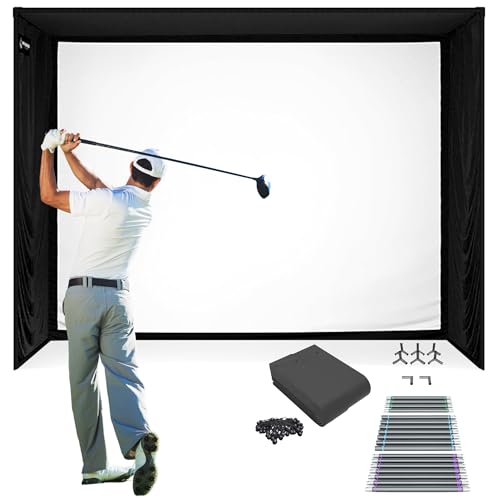
Everything You Need in One Golf Simulator Kit: Enjoy a complete, professional setup right out of the box! The SIG12 Golf Simulator Enclosure includes a durable frame, precision fittings, and our SIGPRO Premium Impact Screen, all engineered for stability, longevity, and a true fairway feel. It can also be integrated seamlessly into optional add-ons like the SIG12 Simulator Flooring and other golf simulator accessories, letting you expand your setup for a clean, studio-quality finish.
Frequently Asked Questions
Can Golf Simulators Accommodate Players of All Skill Levels?
Golf simulators effectively accommodate players of all skill levels, featuring beginner-friendly elements alongside skill level adjustments. This inclusive environment fosters a sense of community, allowing everyone to enjoy learning and improving together in an engaging setting.
How Much Space Do I Need for a Golf Simulator?
A golf simulator typically requires a minimum room size of 12 feet long, 10 feet wide, and 8.5 feet high, while space variations can accommodate smaller setups through adjustments in equipment placement and configurations.
Are There Costs Associated With Simulator Maintenance?
Costs associated with simulator maintenance ironically mount higher than expected. The initial setup may gleam, yet hardware upgrades and routine upkeep quickly transform enthusiasm into an ongoing budget commitment, grounding excitement in financial realism for aspiring golfing enthusiasts.
Do Simulators Provide Realistic Putting Experiences?
Simulators offer a moderate level of virtual realism for putting performance, enabling practice on speed control and alignment. However, they cannot fully replicate the tactile feedback and environmental nuances of authentic greens, impacting the overall experience.
How Often Should I Practice on a Simulator for Improvement?
Practicing on a simulator 2-3 times weekly enhances improvement through structured practice routines. Incorporating swing analysis and specific drills promotes skill development, creating a sense of community among players aiming for progress and shared experiences.